
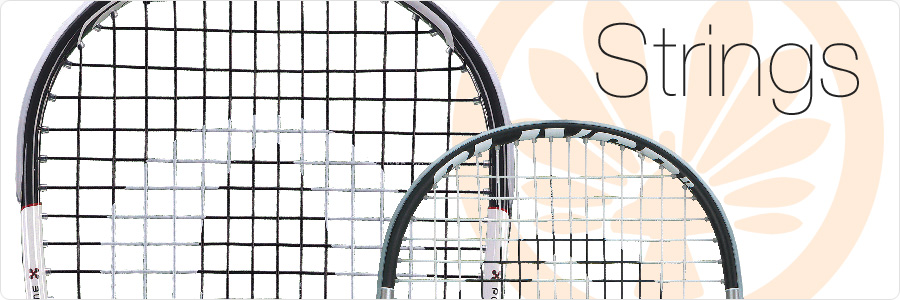
String Matters: Why Strings Are the Real Game-Changer in Squash
Players often spend hours debating the relative merits of one racket over another, planning weeks ahead to buy a new frame. Yet strangely, almost no one pays serious attention to the string – arguably the most critical part of the equipment. In fact, you don’t actually hit the ball with your racket frame (at least not intentionally) – you hit it with the strings.
Of course, the racket is important – it holds the strings. But it’s the string that delivers the power, control, and “feel” behind every shot. In squash, strings are like tires in cycling or sails in sailing: you won’t get far without them, and their quality makes all the difference. The more you understand about strings, the more effectively you can choose the setup that matches your game.
Surprisingly, squash strings are highly technical products, even if the differences aren’t always obvious. Key variables include gauge (thickness), materials, and construction. String tension and racket design also influence performance. Add to that each player’s unique technique, playing style, and budget, and string selection becomes anything but simple.
But don’t worry – while it may not seem easy, it’s not rocket science either. In this article series, we’ll explore all the key issues individually and in combination to help you choose the best strings for your game. We won’t rank brands but aim to give you enough information to analyze manufacturer claims and decide which strings are worth trying.
That’s the key: “worth trying.” No matter how much theory you read, the only real way to know if a string suits you is to play with it. So here’s my number one piece of advice: change strings regularly and test different types until you find the one that fits you best. You might be surprised how much your game improves.
Gauge Awareness
String gauge is a fundamental factor. Every player should know the gauge of their strings and how it affects performance.
In general, thinner strings offer more power but break faster. We’ll explore the concept of “power” in more detail later, but for now: thinner strings stretch more on ball impact. This stretch stores energy, which is released as the strings rebound, propelling the ball forward. More stretch equals more power.
There are two main reasons strings break:
- Notching – As you play, the cross strings (short horizontal ones) repeatedly rub against the main strings (long vertical ones), causing tiny cuts that deepen over time until the main string breaks.
- Overstretch – A sudden break from a poorly hit shot, often near the frame, where the string can’t stretch equally on both sides of the ball. The string exceeds its elasticity and snaps.
Thicker strings resist breakage better than thinner ones – but offer less power. Every player must weigh which factor matters more.
Gauge and string thickness are usually listed on the string’s packaging, often in millimeters. As shown in the chart below, each gauge represents a range: thinner strings have higher numbers. Here are the relevant gauges for squash (tennis goes up to 15, badminton down to 22):
| Gauge | Diameter (mm) |
|---|---|
| 18 | 1.06 – 1.15 mm |
| 17 | 1.16 – 1.25 mm |
| 16 | 1.26 – 1.34 mm |
Note: To measure string thickness accurately, you need to remove it from the racket. Tension compresses the string, making on-frame measurements inaccurate.
Squash strings are mostly made in two gauges: 17 and 18. Gauge 18 gives more power but less durability than 17. Gauge 16 is often found in tennis and should be avoided in squash, as it’s too thick for proper power transfer in smaller squash heads.
Unfortunately, some string manufacturers don’t bother producing squash-specific strings. They relabel tennis strings and sell them to uninformed squash players. Now you know better: ask for gauge 17 or 18 only – and if the shop can’t provide that, shop elsewhere.
Do Your Strings Slip? Tension and Its Impact
Tension choice is one of the most important equipment decisions in squash. It used to be relatively simple – wooden rackets, uniform head sizes, and few string options meant that everyone strung between 30 and 40 lbs. A narrow 10 lb window left little room for error.
Today, rackets come in many shapes, materials, and stiffness levels. Recommended tension ranges from 20 to 40 lbs – a 20 lb margin that offers more room for error… or optimization.
General rule:
- Higher tension = more control
- Lower tension = more power
Looser strings stretch more on contact and rebound with trampoline-like force. Tighter strings stretch less, giving better directional control and spin potential.
Head size also matters: larger heads = more stretch = more power. To maintain control, larger heads require higher tension.
Even unused, strings lose about 10% tension per day after stringing. With use, tension drops even faster – due to molecular slippage, not poor technique. Accept it as part of string life. Find your reference tension and use it consistently.
String construction matters too. Monofilament nylon strings are stiff and prone to shifting. Multifilament strings are more elastic but can lose tension faster. Zyex fibers offer both elasticity and tension retention – excellent, but not ideal for everyone. We’ll cover string construction in more depth later.
Your choice of string and tension depends on:
- Playing style
- Shot technique
- Personal preference
Talk to someone who knows squash strings – but remember, the best setup is the one that works for you.
Thick vs. Thin: Power vs. Control
Most of a squash racket’s power comes from the trampoline effect – strings stretching and rebounding. More stretch = more power. Thinner strings stretch more. Looser strings also stretch more. So if you want more power:
Use a thinner string or reduce tension.
But there’s a trade-off: more stretch = less control. Especially on off-center hits, where uneven stretch causes directional inconsistency.
Another factor: dwell time – how long the ball stays on the strings. Stiffer strings release it instantly, making timing easier. Softer strings hold the ball longer, creating unpredictability in angle and feel.
So: thicker or tighter strings = more control; thinner or looser = more power.
But there’s another twist…
At equal tension, thinner strings feel stiffer because they stretch more per pound. So if you switch from a 17-gauge to an 18-gauge string but keep the same tension, you might actually lose power. To compensate, lower the tension slightly (e.g. from 27 lbs to 24 lbs).
This is called “relative tension.”
No matter the gauge, you can adjust tension to balance power and control. But thinner strings sink deeper into the squash ball, giving slightly better grip and control. They also cut through air faster, allowing a quicker swing.
Are these differences huge? Not usually – but advanced players may feel them. Thicker strings last longer and hold tension better, so they can be more economical.
Bottom Line
Whether it’s gauge, tension, or construction – every variable affects your racket’s performance.
Find the combination that suits your game.
Test, adjust, and observe the results.
Because in the end, the string is what truly connects you to the ball.
 SquashWithMe